
What Is a USB-C External Hard Drive?
 By Theo LangUpdated
A USB-C external hard drive is a portable drive that connects to a computer, phone or game console through a USB-C cable. It stores files outside the device, so photos, videos, documents and game data live on the drive instead of the built-in storage. It takes power from the same cable, so it needs no separate power adapter.
What USB-C changes
USB-C is the small oval connector on the drive and on the cable, and it plugs in either way up. The connector is separate from the speed of the drive: a USB-C drive can run at USB 3.0, USB 3.2 Gen 2 or faster, so read the interface on the drive you buy. The Samsung T7 and Lexar ES3 run at USB 3.2 Gen 2, while the WD Elements SE runs at USB 3.0.
How fast the drive reads
Read speed decides how quickly files move on and off the drive. The SanDisk Extreme reads at up to 2000MB/s, the Samsung T7 reads at up to 1,050MB/s, the Lexar ES3 reads at up to 1050MB/s, and the WD Elements SE reads at up to 400MB/s. Those are rated figures from the makers, so the speed you see depends on the port and the host device. Match the speed to the files: large video files benefit from a faster rated read speed than documents do.
Capacity and size
Capacity runs from 500GB on the SanDisk Extreme to 2TB on the Samsung T7, with the Lexar ES3 at 512GB and the WD Elements SE at 1TB. Count the files you plan to keep on the drive, including photos, videos and game data, and pick a capacity with room left over. Size matters for carrying: the WD Elements SE weighs 0.06 lb, the SanDisk Extreme weighs 0.1 lb, the Samsung T7 weighs 0.13 lb, and the Lexar ES3 weighs 42g at 10.5mm thick.
Protection and encryption
Some drives add protection against drops, water and dust. The SanDisk Extreme carries an IP65 rating for water and dust protection with drop protection up to 3M, the Samsung T7 has shock resistance and fall protection up to 6 feet, and the WD Elements SE has drop resistance up to 2 meters. For private files, the SanDisk Extreme and the Lexar ES3 each include 256-bit AES encryption, so set a password on the drive before you store private files on it.
What you need
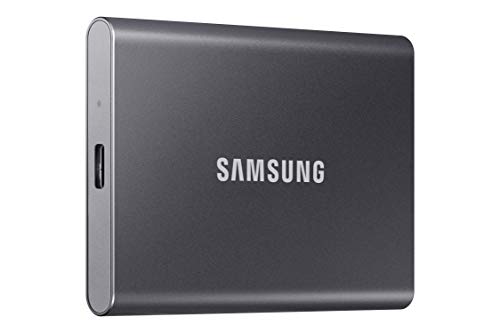
Samsung T7 Portable SSD
A 2TB portable SSD with USB 3.2 Gen 2 and read speeds up to 1,050MB/s, in a solid aluminum unibody with fall protection up to 6 feet.
View on Amazon
SanDisk 500GB Extreme Portable SSD
A 500GB portable SSD with USB-C and read speeds up to 2000MB/s, IP65 water and dust protection, drop protection up to 3M and 256-bit AES encryption.
View on Amazon
WD 1TB Elements SE
A 1TB portable SSD with USB 3.0 and read speeds up to 400MB/s, drop resistance up to 2 meters and plug-and-play use on PC and Mac.
View on Amazon
Lexar ES3 512GB Portable SSD Silver
A 512GB portable SSD with USB 3.2 Gen 2 and read speeds up to 1050MB/s, at 42g and 10.5mm thick, with a Type-C cable and 256-bit AES encryption.
View on AmazonThese come from our ranked list Best Portable SSD Hard Drive, which compares them spec by spec.
FAQ
Do USB-C drives work with phones?
Some do. The Samsung T7 works with a mobile phone, and the Lexar ES3 works with the iPhone 15 series. The Samsung T7 records 4K video at 60fps from a phone or camera. Check that your phone's USB-C port supports an external drive before you buy one for it.
Can you record video straight to the drive?
Yes, on drives that support it. The Samsung T7 records Ultra High Resolution 4K video at 60fps directly from a camera or mobile device, and it supports iPhone 15 ProRes 4K at 60fps video. Check the drive's notes for your camera or phone before you record to it.
How do you pick the right capacity?
Add up the files you plan to store, then pick a drive with room to spare. The SanDisk Extreme holds 500GB, the Lexar ES3 holds 512GB, the WD Elements SE holds 1TB, and the Samsung T7 holds 2TB. A drive that fills up forces you to move files off it, so leave space for new photos, videos and games.


