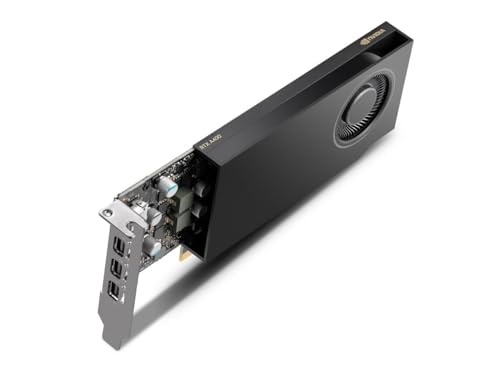
What Does a Laptop Graphics Card Look Like?
 By Theo LangUpdated
A laptop graphics card is a small square chip soldered to the motherboard, hidden under a heatsink and a fan, so there is no separate card to see. What you see is the cooling: a fan and heat pipes over the chip. A desktop graphics card looks different: a long rectangular board with one or more fans, video ports and a backplate.
The chip on the motherboard
In a laptop, the graphics processor is a chip mounted on the main board, next to the processor, with memory chips around it. A metal heatsink and a fan sit on top of it, and heat pipes run from the chip to the fan. Because the chip is soldered down, it does not slide out like a desktop card.
What a desktop card looks like
A desktop graphics card is a long rectangular board that plugs into a slot on the motherboard. One side carries one or more fans, and the other side can have a metal backplate. The end of the card has video ports such as HDMI and DisplayPort for a monitor. The cards here show this shape: the ASUS PRIME cards have Axial-tech fans and a 2.5-slot design, the 16 GB ASUS PRIME card also has a metal backplate, and the MSI card is a low-profile board.
How to tell which graphics your laptop has
Check the laptop's spec sheet or the system settings for the graphics name, such as GeForce RTX 5060 Ti or GeForce RTX 3050. The name tells you the model, and the video memory figure tells you how much memory the card has: 16 GB, 8 GB or 6 GB on the cards here.
Check the ports and the cooling
Look at the video ports on the end of the card: the ASUS PRIME cards have HDMI and DisplayPort 2.1, and the MSI card has one DisplayPort 1.4a and two HDMI 2.1a ports. Fans sit on the front of the card and pull air over the heatsink, and the ASUS cards add a Dual BIOS switch for Quiet and Performance profiles. A card that takes two slots or more needs that much room in the case.
What you need

ASUS PRIME GeForce RTX 5060 Ti 16GB
A GeForce RTX 5060 Ti card with 16 GB of GDDR7 memory, Axial-tech fans, a 2.5-slot design and a backplate, with a 3-year warranty.
View on Amazon
ASUS Prime GeForce RTX 5060 Ti 8GB
A GeForce RTX 5060 Ti card with 8 GB of GDDR7 memory, Axial-tech fans and a 2.5-slot design, with a 3-year warranty.
View on Amazon
MSI Gaming RTX 3050 LP 6G OC Graphics Card
A low-profile GeForce RTX 3050 card with 6 GB of GDDR6 memory, a 1492 MHz boost clock, HDMI and DisplayPort outputs and a 3-year warranty.
View on Amazon
NVIDIA RTX 4000 SFF Ada Generation Workstation Ada Lovelace Architecture Dual Slot Low Profile Professional Graphics Board 900-5G192-2571-000 VD8465
A dual-slot low-profile workstation graphics board built on the Ada Lovelace architecture for rendering and design work.
View on AmazonThese come from our ranked list Best Sff GPU, which compares them spec by spec.
FAQ
Can you see the graphics card in a laptop?
You can see the fan and the heatsink, but the graphics chip sits under them on the motherboard. The chip is soldered down, so there is no separate card to look at or remove.
Can you swap a laptop graphics card?
A soldered graphics chip cannot be swapped, so check your laptop's manual to see whether its graphics is a separate module.
What ports does a graphics card have?
The ASUS PRIME cards and the MSI card have HDMI and DisplayPort outputs for a monitor. The ASUS PRIME cards have HDMI and DisplayPort 2.1, and the MSI card has one DisplayPort 1.4a port and two HDMI 2.1a ports.