What Does Ti Mean in a GPU Name?
 By Theo LangUpdated
Ti stands for Titanium. NVIDIA adds Ti to a graphics card model to mark a card that sits above the base card in the same series. The letters do not describe a separate kind of card. They mark a step up inside one series, and you still compare cards by their full model and published specs.
What Ti stands for
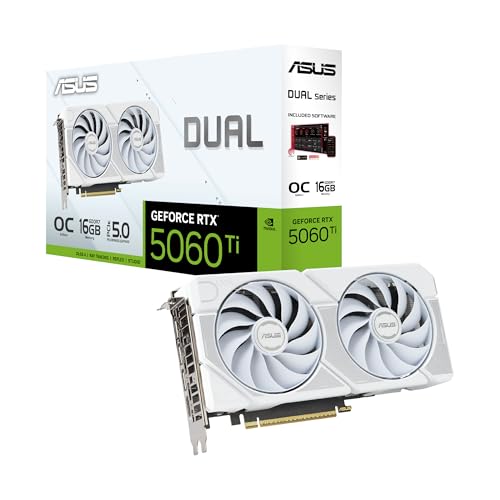
Ti stands for Titanium, the metal in the letters. NVIDIA uses Ti as a suffix on some GeForce cards to mark a card that sits above the base card with the same number. The suffix is part of the model, so it appears in the card's full model, as in GeForce RTX 5060 Ti. It does not add a port, change the card's size or set its memory amount on its own.
Where Ti sits in a series
Read Ti as a step inside one series, not as a rank across all cards. A Ti card sits above the base card with the same number, but the letters alone do not place it against a card from another series or a workstation card such as the NVIDIA RTX 4000 SFF Ada Generation. To compare two cards, match the full series first, then look at the memory, ports and size each card has.
What Ti does not tell you
Ti says nothing on its own about memory size, ports, cooling or card size. The two ASUS PRIME GeForce RTX 5060 Ti cards show this: one has 16 GB of GDDR7 memory and the other has 8 GB of GDDR7 memory, while both carry the same Ti suffix. Both have PCIe 5.0 and HDMI/DP 2.1, a 2.5-slot design, Axial-tech fans and Dual BIOS. Check those figures on each card instead of reading them from the Ti letters.
How to read a full GPU model
Start with the brand and the series, then read the suffix and the memory. ASUS PRIME GeForce RTX 5060 Ti 16GB GDDR7 OC Edition gives the maker, the GeForce RTX 5060 Ti series card, 16 GB of GDDR7 memory and an OC Edition. The OC Edition has an OC mode of 2647 MHz and a default mode of 2617 MHz. A card without Ti, such as the msi Gaming RTX 3050 LP 6G OC, has 6 GB of GDDR6 memory and a boost clock of 1492 MHz instead.
What you need

ASUS PRIME GeForce RTX 5060 Ti 16GB
A GeForce RTX 5060 Ti card with 16 GB of GDDR7 memory, PCIe 5.0, HDMI/DP 2.1, a 2.5-slot design and Axial-tech fans.
View on Amazon
ASUS Prime GeForce RTX 5060 Ti 8GB
A GeForce RTX 5060 Ti card with 8 GB of GDDR7 memory, PCIe 5.0, HDMI/DP 2.1, a 2.5-slot design and Dual BIOS.
View on Amazon
MSI Gaming RTX 3050 LP 6G OC Graphics Card
A GeForce RTX 3050 card without Ti, with 6 GB of GDDR6 memory, a 96-bit interface and a boost clock of 1492 MHz.
View on Amazon
NVIDIA RTX 4000 SFF Ada Generation Workstation Ada Lovelace Architecture Dual Slot Low Profile Professional Graphics Board 900-5G192-2571-000 VD8465
An NVIDIA RTX 4000 SFF Ada Generation workstation card with a dual-slot low-profile design.
View on AmazonThese come from our ranked list Best Sff GPU, which compares them spec by spec.
FAQ
Is a Ti card always better than a non-Ti card?
Only inside the same series. A Ti card sits above the base card with the same number, but the letters alone do not rank cards from different series. Compare the full model and the memory, ports and size before you choose.
Does Ti mean more video memory?
No. The two ASUS PRIME GeForce RTX 5060 Ti cards carry the same Ti suffix with different memory: one has 16 GB of GDDR7 and the other has 8 GB of GDDR7. Memory is a separate figure in the card's model, so read it on its own.
What does OC mean in a GPU model?
OC marks an overclocked edition. The ASUS PRIME GeForce RTX 5060 Ti OC Edition has an OC mode of 2647 MHz and a default mode of 2617 MHz, so the OC mode runs at the higher clock.