
Do You Need Noise Cancelling Headphones?
 By Theo LangUpdated
No, you do not need noise cancelling headphones for every kind of listening. You need them when steady background noise makes it hard to hear music, calls or a show at a comfortable volume. With 40mm drivers behind the sound, a comfortable volume is enough for the room, so ordinary headphones do the job, while noise cancelling helps most on trains, in offices and on flights.
What noise cancelling does
Noise cancelling uses microphones to pick up outside sound and lower it before it reaches your ears, so steady noise fades while music, calls or a show stay clear. All four models here have 40mm drivers. The Q20i models and the bmani have a transparency mode for times when you need to hear what is around you, and the Q20i also has a normal mode. It lowers background noise, it does not remove every sound.
When it helps most
Noise cancelling helps most where steady noise runs for a long time, such as on a train, in an office, on a flight or in a busy cafe. In those places it lets you listen at a lower volume and hear calls without raising your voice. If the noise around you changes all the time, or you need to hear every announcement, the benefit is smaller.
When ordinary headphones are enough
Ordinary headphones are enough where 40mm drivers at a comfortable volume carry the sound, for short listening, and when you want to stay aware of the room. Noise cancelling adds microphones, modes and app settings to manage, and it needs charging to keep working. If you rarely sit in steady background noise, that extra layer adds little to the listening you already do.
Check battery, modes and connection before choosing
Battery life differs by model: the Q20i has 40 hours with noise cancelling on and 60 hours in normal mode, while the TOZO HT3 lists 90 hours of playback and the bmani 120 hours. Check the modes too: the Q20i has ANC, Normal and Transparency modes, and the TOZO HT3 has 32 EQ modes in its app. All four have Bluetooth, and the TOZO HT3 and the bmani have Bluetooth 6.0, while the Q20i has Bluetooth 5.0.
What you need

soundcore by Anker Q20i Hybrid Active Noise Cancelling Headphones
Black over-ear headphones with hybrid noise cancelling, 40mm drivers, Bluetooth 5.0, 40 hours of playtime with noise cancelling on and a transparency mode.
View on Amazon
Soundcore by Anker Q20i Hybrid Active Noise Cancelling Headphones
Taupe over-ear headphones with hybrid noise cancelling, 40mm drivers, Bluetooth 5.0, 60 hours of playtime in normal mode and 22 EQ presets in the app.
View on Amazon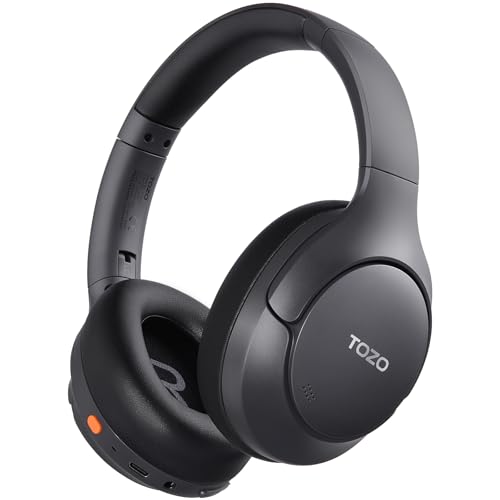
TOZO HT3 Hybrid Noise Cancelling Wireless Headphones
Hybrid noise cancelling headphones with 40mm drivers, Bluetooth 6.0, 90 hours of playtime, 32 EQ modes and a foldable design.
View on Amazon
Hybrid Active Noise Cancelling Headphones
Hybrid noise cancelling headphones with 40mm drivers, Bluetooth 6.0, 120 hours of playtime, 6-mic calls and a digital battery display.
View on AmazonThese come from our ranked list Best Noise Cancelling Headphones for PC, which compares them spec by spec.
FAQ
Does noise cancelling remove all sound?
No. The Q20i reduces up to 90% of external noise, and the bmani up to 95%, so some sound still gets through. Use transparency mode when you need to hear announcements or traffic.
How long do these headphones play with noise cancelling on?
The Q20i has 40 hours with noise cancelling on and 60 hours in normal mode, while the TOZO HT3 lists 90 hours of playback and the bmani 120 hours. Check the figure for the model you choose, as normal mode lasts longer on the Q20i.
Can I use noise cancelling headphones for calls?
Yes. The Q20i has 2 internal and 2 external microphones, the TOZO HT3 5 microphones, and the bmani 6 microphones for calls. Dual device connection on the Q20i and the TOZO HT3 lets you switch between a phone and a computer.
What is transparency mode?
Transparency mode lets outside sound in, so announcements and traffic stay audible while you listen. The Q20i and the bmani have transparency mode, and the Q20i lets you switch between ANC, Normal and Transparency modes.


