
What Is a PC Tower?
 By Theo LangUpdated
A PC tower is the upright case that holds the parts of a desktop computer: the motherboard, processor, graphics card, memory, storage and power supply. It stands on or beside a desk, connects to a monitor, keyboard and mouse, and gives the parts room for airflow and later changes. The four cases below show the range, from ATX dual-chamber cases to E-ATX full towers.
What sits inside a tower
A tower holds the motherboard, which links the processor, memory, storage and graphics card, plus the power supply that feeds them. The case gives each part a mounting point and keeps cables routed out of the airflow path. A monitor, keyboard and mouse plug into the ports on the back, while the power button and front USB ports sit within reach on the case itself.
Check the form factor first
Form factor decides which motherboards fit. The HYTE Y70 cases here are ATX cases with a dual-chamber interior, while the Antec Flux Pro and the Antec Performance 1 FT are E-ATX full towers. An E-ATX board is larger than an ATX board, so it needs a case that lists E-ATX support. Read the form factor on your motherboard or its box, then pick a case that lists the same form factor.
Cooling and fan space
A tower moves air across hot parts with fans and radiators. The HYTE Y70 fits up to 10 fans and a radiator up to 360mm on the side, while the Antec Flux Pro fits up to 12 fans and a 420mm radiator plus a 360mm radiator at the same time. Check how many fan mounts the case lists and where they sit, then match them to the fans and radiator you plan to use.
Size, weight and where it sits
Full towers are large and heavy, so measure the space first. The Antec Flux Pro weighs 29 lb, the Antec Performance 1 FT weighs 27.67 lb, and the HYTE Y70 cases weigh 24.4 lb. A case under a desk needs clearance for the side panel and the cables at the back, while a case on a desk needs a surface that holds its weight. Check the weight and the depth before you order.
Extra features worth a look
Some cases add a screen, a temperature readout or a glass panel. The HYTE Y70 has a 14.9-inch LCD touchscreen at 682 x 2560 with 10-point multi-touch, and a PCIe 4.0 riser cable for vertical graphics card mounting. The Antec Flux Pro shows CPU and GPU temperatures on a display, and the Antec Performance 1 FT has a temperature display and dual tempered glass side panels. Treat these as extras, not as a reason to pick a case with the wrong form factor.
What you need

HYTE Y70 Touch Infinite Modern Aesthetic Gaming PC Case
An ATX dual-chamber case in Snow White with a 14.9-inch LCD touchscreen, a PCIe 4.0 riser cable and room for up to 10 fans.
View on Amazon
Antec Flux Pro Full-Tower E-ATX PC Case
An E-ATX full tower with 6 PWM fans, room for up to 12 fans, a 420mm radiator, a walnut wood front panel and a CPU and GPU temperature display.
View on Amazon
HYTE Y70 Touch Infinite Modern Aesthetic Gaming PC Case
An ATX dual-chamber case in Pitch Black with a 14.9-inch LCD touchscreen, a PCIe 4.0 riser cable and room for up to 10 fans.
View on Amazon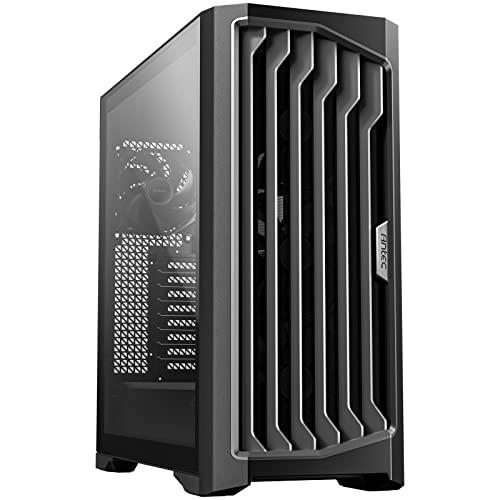
Antec Performance 1 FT Full Tower E-ATX PC Case
An E-ATX full tower with a high-airflow mesh front panel, a temperature display, dual tempered glass side panels and a Type-C 10Gbps port.
View on AmazonThese come from our ranked list Best PC Tower Case, which compares them spec by spec.
FAQ
Is a PC tower the same as a desktop computer?
No. The tower is the case that holds the parts, while the desktop computer is the whole working machine with the parts, monitor, keyboard and mouse. You buy a tower case when you build or rebuild a PC, and you buy a desktop computer when you want the finished machine.
What size motherboard fits in these cases?
The HYTE Y70 cases fit ATX motherboards, and the Antec Flux Pro and the Antec Performance 1 FT fit E-ATX motherboards. Check the form factor on your motherboard, then pick a case that lists the same form factor.
Do I need a full tower case?
Only if your parts need the room. A full tower like the Antec Flux Pro gives space for large radiators and many fans, with room for up to 12 fans and a 420mm radiator plus a 360mm radiator, while an ATX case like the HYTE Y70 fits a standard board in less space. Match the case to the parts you plan to install.


