What Does Gigahertz Mean in a Processor?
 By Theo LangUpdated
Gigahertz, written as GHz, is the clock speed of a processor, measured in cycles per second. One gigahertz means one billion cycles each second, so a processor at 4.6 GHz runs up to 4.6 billion cycles each second. The number tells you how fast the processor clock ticks, not how much work it finishes in each tick.
What one cycle does
Each cycle is one tick of the processor internal clock, and the processor carries out part of an instruction on each tick. A higher clock speed means more ticks each second, so the processor starts each small step sooner. The work done in a single tick depends on the processor design, so clock speed alone does not fix how fast a whole task runs. Cache size, core count and the memory the processor supports also shape the result.
Base clock and boost clock
Listings show two clock figures for some processors: a base clock and a max boost clock. The base clock is the speed the processor holds under steady load, while the boost clock is the higher speed it reaches for short bursts when the work and the cooling allow it. The AMD Ryzen 9 9950X3D has a 4.3 GHz base clock and a max boost clock up to 5.7 GHz. Compare boost figures with boost figures, and base with base, since the two numbers describe different running states.
Why a higher number is not always faster
Two processors at the same clock speed can finish work at different rates, because each tick can do a different amount of work. A newer design can do more per tick than an older one, and a processor with more cores can split work across cores. The AMD Ryzen 7 5700X has 8 cores and a 4.6 GHz max boost, while the AMD Ryzen 9 9900X has 12 cores and a 5.6 GHz max boost, so the two differ in both clock speed and core count. Read the core count, cache and memory support next to the clock speed.
What to check next to the clock speed
Clock speed sits next to other figures on a processor listing. Core and thread counts say how many tasks the processor can work on at once: the AMD Ryzen 7 5800X3D has 8 cores and 16 threads, and the AMD Ryzen 9 9900X has 12 cores and 24 threads. Cache gives the processor fast storage close by: the 5700X has 36 MB cache and the 9900X has 76 MB cache. The socket matters too, since the 5700X and the 5800X3D use Socket AM4 and the 9950X3D and the 9900X use Socket AM5. Check that the socket matches your motherboard before you buy.
What you need

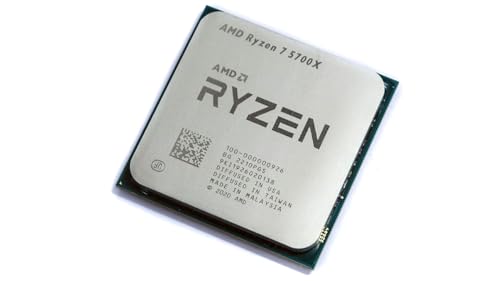
AMD Ryzen 7 5700X 8-Core
An 8-core, 16-thread processor with a 4.6 GHz max boost, 36 MB cache and DDR4-3200 support on Socket AM4.
View on Amazon
AMD Ryzen 7 5800X3D 8-core
An 8-core, 16-thread processor with a 4.5 GHz max boost, 100 MB cache and 3D V-Cache technology on Socket AM4.
View on Amazon
AMD Ryzen 9 9950X3D 16-Core Processor
A 16-core processor with a 5.7 GHz max boost clock, a 4.3 GHz base clock and Zen 5 architecture on Socket AM5.
View on Amazon
AMD Ryzen 9 9900X 12-Core
A 12-core, 24-thread processor with a 5.6 GHz max boost, 76 MB cache and DDR5-5600 support on Socket AM5.
View on AmazonThese come from our ranked list Best CPU for Computer, which compares them spec by spec.
FAQ
Does a higher gigahertz number mean a faster processor?
Not on its own. Clock speed counts ticks per second, but each tick can do a different amount of work, so core count, cache and design matter too. Compare processors by clock speed together with cores and cache, not by gigahertz alone.
What is the difference between base clock and boost clock?
The base clock is the steady speed under load, and the boost clock is the higher speed for short bursts. The AMD Ryzen 9 9950X3D has a 4.3 GHz base clock and a 5.7 GHz max boost clock.
Do more cores matter more than gigahertz?
Both matter, for different reasons. More cores let the processor work on more tasks at once, while a higher clock speed runs each tick faster. The AMD Ryzen 9 9900X has 12 cores with a 5.6 GHz max boost, and the AMD Ryzen 7 5700X has 8 cores with a 4.6 GHz max boost.
What does GHz stand for?
GHz stands for gigahertz, a unit of frequency equal to one billion cycles per second. A processor at 5.6 GHz, like the AMD Ryzen 9 9900X, runs up to 5.6 billion cycles each second at its max boost.