What Does an i5 Processor Mean?
 By Theo LangUpdated
A CPU is the chip that handles the instructions behind every program on a computer, from a browser tab to a game. An i5 or Ryzen 7 mark shows the maker's tier for the processor, and the numbers that matter are cores, threads, clock speed, cache and socket. Read those figures and the processor name starts to make sense.
What a CPU does
The CPU reads instructions and does the arithmetic behind every program you open, from a web browser to a game. It fetches data from memory, works through it, and sends the result back. A faster chip finishes each step sooner, and a chip with more cores works through more steps at once. That is why the processor sits at the center of every desktop build.
Cores and threads
A core is a processing unit inside the chip, and a thread is a stream of work a core can handle. A processor with more cores and threads can juggle more streams at once, which helps when a program splits its work. The Ryzen 7 5700X has 8 cores and 16 threads, and the Ryzen 9 9900X has 12 cores and 24 threads. The Ryzen 7 5800X3D has 8 cores and 16 threads with AMD 3D V-Cache technology.
Clock speed and cache
Clock speed, measured in GHz, is how many cycles the chip runs each second, and max boost is the boost clock speed the maker gives for the chip. Cache is fast memory on the chip itself, so a larger cache keeps more data close at hand. The Ryzen 7 5700X has a 4.6 GHz max boost with 36 MB cache, and the Ryzen 9 9900X has a 5.6 GHz max boost with 76 MB cache. The Ryzen 9 9950X3D has a 5.7 GHz max boost with a 4.3 GHz base clock.
Socket, memory and cooler
The socket is the fitting on the motherboard, and a processor only fits the socket made for it. The Ryzen 7 5700X and Ryzen 7 5800X3D use the AM4 socket with DDR4-3200 support, while the Ryzen 9 9900X uses the AM5 socket with DDR5-5600 support. Match the board to the socket first, and check that the board takes the memory type the processor uses.
What you need

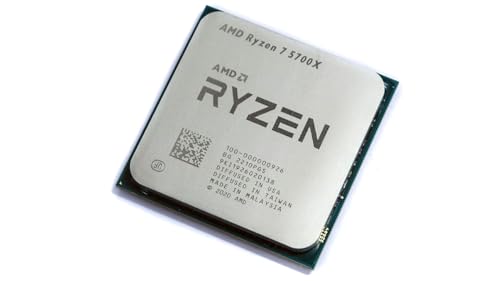
AMD Ryzen 7 5700X 8-Core
An 8-core, 16-thread Ryzen 7 with a 4.6 GHz max boost, 36 MB cache and AM4 socket, with no cooler in the box.
View on Amazon
AMD Ryzen 7 5800X3D 8-core
An 8-core, 16-thread Ryzen 7 with 3D V-Cache, a 4.5 GHz max boost, 100 MB cache and AM4 socket.
View on Amazon
AMD Ryzen 9 9950X3D 16-Core Processor
A 16-core Ryzen 9 with a 5.7 GHz max boost, 4.3 GHz base clock and AM5 socket, for gaming and content creation.
View on Amazon
AMD Ryzen 9 9900X 12-Core
A 12-core, 24-thread Ryzen 9 with a 5.6 GHz max boost, 76 MB cache, DDR5-5600 support and AM5 socket.
View on AmazonThese come from our ranked list Best CPU for Computer, which compares them spec by spec.
FAQ
What does i5 mean in a processor name?
The i5 in a processor name marks Intel's mid-range line, and the numbers after it describe the model. Read the cores, threads, clock speed and socket instead of the tier name alone.
Do more cores help with gaming?
More cores help when a game or program splits its work across them. The Ryzen 9 9900X has 12 cores and 24 threads, while the Ryzen 7 5700X has 8 cores and 16 threads, so check the requirements published for the software you run.
What is the difference between AM4 and AM5?
They are different sockets, so a processor for one does not fit a board for the other. The 5700X and 5800X3D use AM4 with DDR4-3200 support, while the 9900X uses AM5 with DDR5-5600 support.