What Are Mobile Processors?
 By Theo LangUpdated
A mobile processor is the main processor in a laptop, tablet or phone, built to run on battery power in a thin case with limited cooling. It does the same basic job as a desktop processor, but the design puts battery life and heat ahead of the higher power limits of a desktop.
What a mobile processor does
A mobile processor runs the operating system and apps, and it coordinates memory, storage and graphics work. In many laptops and tablets the processor also includes graphics on the same chip, so the device does not need a separate graphics card for basic display output. The processor sits on the main board inside the device, and the maker chooses it as part of the whole laptop or tablet design. You buy the processor as part of the device, not as a separate part to install later.
How mobile differs from desktop
Desktop processors use sockets such as AM4 and AM5 and install in a motherboard with a separate cooler. The AMD Ryzen 7 5700X and Ryzen 7 5800X3D use Socket AM4, while the Ryzen 9 9950X3D and Ryzen 9 9900X use Socket AM5. A mobile processor is made for a portable device with a battery and a small cooling system, so the device maker sets the power and cooling limits for the whole machine. Check the device maker's manual for what can be serviced or replaced.
Cores, threads and clock speed
Cores are the processing units inside the processor, and threads are the work streams those cores handle. The AMD Ryzen 7 5700X has 8 cores and 16 threads with a 4.6 GHz max boost clock. The AMD Ryzen 9 9900X has 12 cores and 24 threads with a 5.6 GHz max boost clock. Clock speed names how fast the processor cycles, and boost clock is the higher speed the maker states for short periods. Compare these figures only with the requirements published for your software.
Cache, memory and platform support
Cache is fast memory on the processor that holds data close to the cores. The AMD Ryzen 7 5700X has 36 MB cache with DDR4-3200 support, and the AMD Ryzen 7 5800X3D has 100 MB cache with DDR4-3200 support. The AMD Ryzen 9 9900X has 76 MB cache with DDR5-5600 support and PCIe 5.0 support on select motherboards. Memory type and platform support must match the motherboard or device. Read the processor and motherboard documents together before you buy parts.
What you need

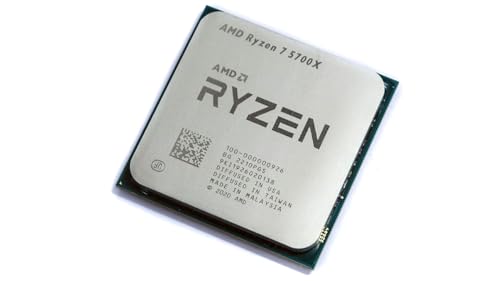
AMD Ryzen 7 5700X 8-Core
A desktop processor with 8 cores, 16 threads, 4.6 GHz max boost and Socket AM4, shown here as a desktop contrast.
View on Amazon
AMD Ryzen 7 5800X3D 8-core
A desktop processor with 8 cores, 16 threads, 4.5 GHz max boost, 100 MB cache and Socket AM4.
View on Amazon
AMD Ryzen 9 9950X3D 16-Core Processor
A desktop processor with 16 cores, up to 5.7 GHz max boost clock and Socket AM5 for desktop builds.
View on Amazon
AMD Ryzen 9 9900X 12-Core
A desktop processor with 12 cores, 24 threads, 5.6 GHz max boost, 76 MB cache and Socket AM5.
View on AmazonThese come from our ranked list Best CPU for Computer, which compares them spec by spec.
FAQ
Is a mobile processor the same as a desktop processor?
No. Both process instructions, but a mobile processor is built for a battery-powered portable device with limited cooling. The AMD Ryzen 7 5700X, Ryzen 7 5800X3D, Ryzen 9 9950X3D and Ryzen 9 9900X are desktop processors for Socket AM4 and Socket AM5 motherboards.
Can I replace a mobile processor in a laptop?
Check the maker's manual for your exact laptop model before you open it. Shut the laptop down and unplug it before any service work. If the manual does not cover processor replacement, contact the maker.
What do cores and threads mean on a processor?
Cores are processing units, and threads are work streams. The AMD Ryzen 7 5800X3D has 8 cores and 16 threads. The AMD Ryzen 9 9950X3D has 16 cores for desktop use.